
Post Type
Bay Area 6th Cycle Housing Element Action Database
Introduction to the Bay Area 6th Cycle Housing Element Action Database
In an effort to make it easier for Bay Area housing organizations and local officials to compare, analyze and search the policy goals in current 6th Cycle Housing Elements, Public Advocates and the Housing Element Working Group have developed a database featuring 84 of the region’s 109 jurisdictions.
The database can be used to more easily compare jurisdictions, or to see which jurisdictions share a commitment to a certain type of policy area. It can be used to drill down into the text of specific areas of policies, or to produce high-level analysis of the region as a whole, or of all jurisdictions in a County.
How to Access the Database
The database is housed on an Airtable. Click here and you will be taken to the database.
What’s in the Database?
In the database, you will find two types of information.
From the Housing Elements, it includes:
- The text of all Program sections of included Housing Elements. Programs make up the jurisdictions’ substantial commitments to pursue a variety of policy objectives, including fair housing objectives. Programs can include many different policy areas.
- Deadlines and checkpoints for the implementation of each program, if included
- Quantified deliverables and objectives,if included
- Whether the program relates to the jurisdiction’s strategies to affirmatively further fair housing, and which AFFH “themes” they seek to address (preventing displacement, addressing needs of special populations, etc.)
We also include a series of columns generated by the research team:
- Categories of housing policy for each individual Program – i.e. Tenant Protections, Rezoning, Etc. Some programs are tagged with multiple categories.
- Whether the Program makes a firm policy commitment, discusses funding for the program, or focuses on practice-based changes
- Whether the program is targeted to a specific zone or group, or is citywide
- Whether a program is focused on Outreach, Studying or Monitoring
Below is a list of each field in the database, with a description and the source.
Database Fields
Program number as appearing in housing element. Note that numbering systems vary between elements, and some programs are not numbered.
Where there is inconsistency in how programs are numbered, we’ve flagged the incorrect numbering with a [sic].
Source: Housing element
Title of program as appears in the housing element. Note that not all programs have titles.
Source: Housing element
Body of program text from housing element. Note that each housing element organizes text under different headers. Text from these fields variously described in the housing element as “Program description,” “Action,” etc.
Source: Housing element
Text outlining goals, objectives, and other tangible measures of progress. Field may be blank where the housing element did not have a comparable section, or duplicated with “deliverable date” where the housing element discussed objectives and timelines in the same section.
Source: Housing element
A yes or no field that shows whether the jurisdiction in question tagged this program as Affirmatively Furthering Fair Housing.
General categories of fair housing actions that the housing element associated with each program. Variously described in housing elements as “AFFH goals” “AFFH strategies,” “fair housing objective” etc.
For ease of use of the database, where housing element presented multiple fields that describe fair housing objectives, the more concise or precise of the fields is presented here.
Source: Housing element
Text setting out deadlines, checkpoints, etc. Field may be blank where the housing element did not have a comparable section, or duplicated with “deliverable” where the housing element discussed objectives and timelines in the same section.
Source: Housing element
One or more of the following categories:
- Administrative Process
- ADUs
- Affordable Housing Development
- Below Market Rate Housing
- Capital Improvement Projects/Infrastructure Projects
- Code Enforcement
- Community Engagement
- Community Land Trusts
- Development
- Development Process
- Economic Development/Workforce Development
- Engagement Process
- Environmental
- Fair Housing Enforcement and Outreach
- Funding
- Homeownership
- Homeownership Assistance
- Inclusionary Zoning
- Large Projects
- Middle Income Housing
- Miscellaneous
- Monitoring
- Preservation
- Redevelopment/rehabilitation
- Regional Collaboration
- Rental Housing Assistance
- Rental Housing Assistance
- Rezoning
- Rezoning: AFFH
- Special Needs Housing
- Staff Capacity
- State Compliance
- Tenant Protections
- TOPA/COPA
- Workforce Housing
Source: Schafran Strategies team
Policy: Actual change in an ordinance or regulation
Funding: Specifically related to pursuing or granting funding
Practice: Related to actions taken by planning (or other city government) staff that are not the product of a concrete policy change and are not related to funding (basically, everything else)
No change: action discusses existing policies.
Source: Schafran Strategies team
Outreach/Study/Monitoring: Action does not have any immediate impact, but is instead focused on studying a particular policy option or conducting outreach
Area/Zone/Site: Action is targeted towards a specific area (i.e. neighborhood(s)), zone (i.e. R1 zones), or site (i.e. “development site at such-and-such address”)
Group: Action is targeted towards a specifically defined group (may include voucher recipients, disabled, homeless, veterans, etc.). Note: this should probably not include “low-income households” in general, which is overly vague and based on a more variable status (that could change from year to year).
Citywide: Concrete action that applies across the city, such as a change in a citywide ordinance (ex: rent control)
Source: Schafran Strategies team
Things to keep in mind
Most jurisdictions have all of their programs included in the database. Some jurisdictions placed programs in an “AFFH matrix,” another chapter of the housing element where the jurisdiction lays out their fair housing strategies. For these jurisdictions, the list of programs in the dataset may not be comprehensive, and the text might be somewhat abridged. See below for the list of included jurisdictions, and whether the data is pulled from their comprehensive programs section or the AFFH matrix.
How the database was built
The pertinent sections of each Housing Element were pulled by hand by the team at Schafran Strategies and built into the initial database. This includes all columns identified above as coming from the Housing Elements themselves. Jurisdictions were included as they were certified by HCD, with the exception of Marin County.
We then developed a ‘coding structure’ in collaboration with the Housing Element Working Group which identified the categories of housing policy and the analysis of the scale and type of action. We compiled actions from each housing element were into a database and categorized them based on these components. Some actions included a single standalone action, while others consisted of a series of actions. All components of an action were considered in the categorization process, and some programs received multiple tags because they addressed multiple topics, types of action, or scales of impact.
Categories
We identified thirty program topic categories based on the actual content of the housing elements. These are not mutually exclusive – some programs are tagged multiple times, in part because some programs have many different policy areas. The categories were built from the content, and are meant to identify key themes. Some categories are actually subcategories of larger areas.
Type of Actions
The type of action refers to the mechanism of change: a policy change, a practice change, or a funding commitment.
- Policy changes propose modifications to an ordinance or regulation.
- Funding programs involve pursuing or granting funding.
- Practice changes refer to proposed actions or programmatic adjustments carried out by staff or the jurisdiction.
Scale of Action
The scale of action refers to the level of impact: area/site/zone, group, or citywide.
- Area/site/zone actions target a specific neighborhood, zone, or site.
- Group actions focus on a defined group.
- Citywide actions apply across the entire city.
Study/Outreach/Monitoring Action
Study/outreach/monitoring actions have a less concrete scale of impact and focus on program monitoring, studying a policy option, or conducting outreach.
Pages
All programs is the “homepage” for the database and presents the housing element programs in an easy-to-reference format. Users can sort the programs by jurisdiction, county, AFFH objectives, and the qualitative categories created by the Schafran Strategies team.
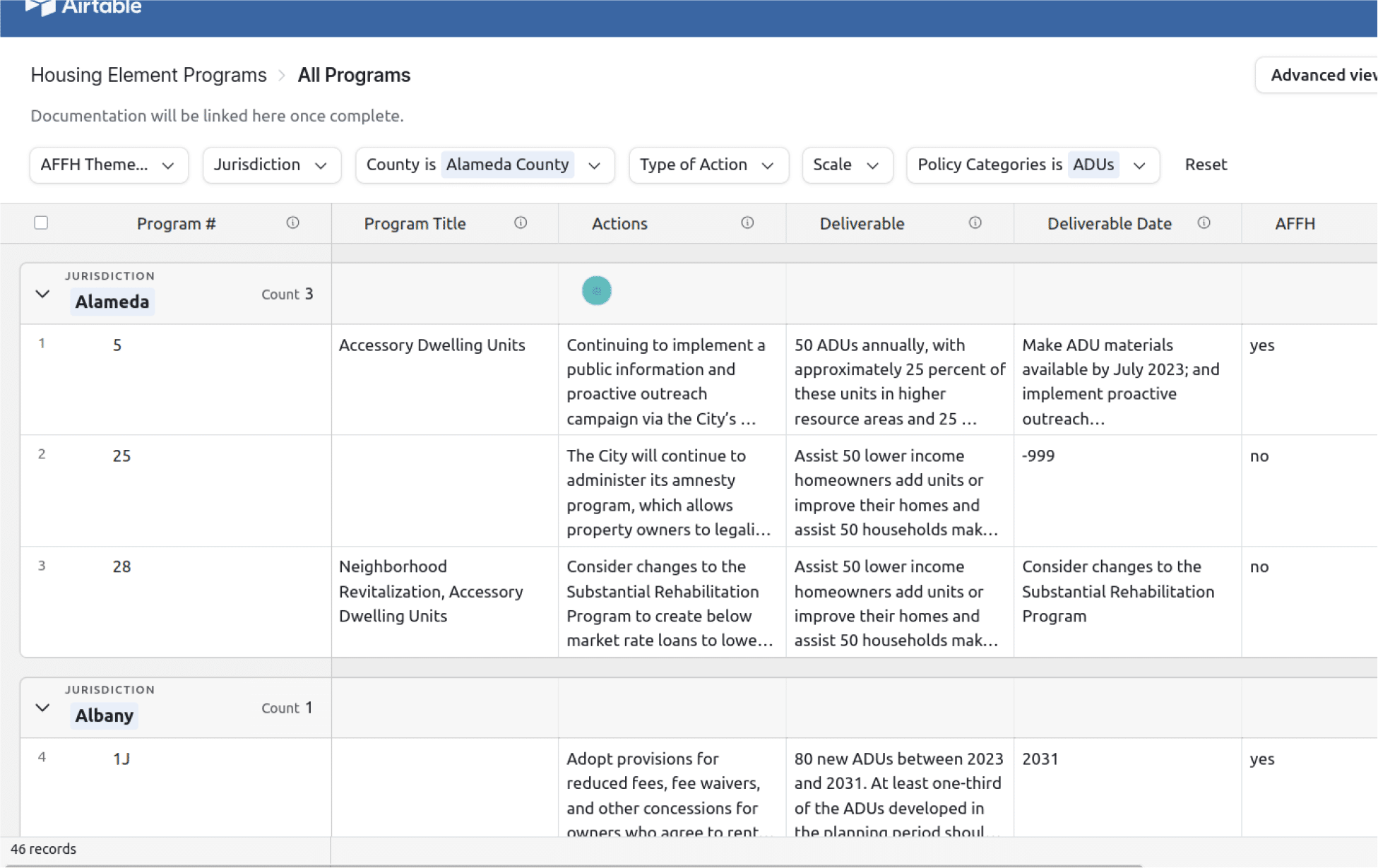
Pictured: The “All Programs” page, sorted to include all ADU programs proposed by Alameda County jurisdictions.
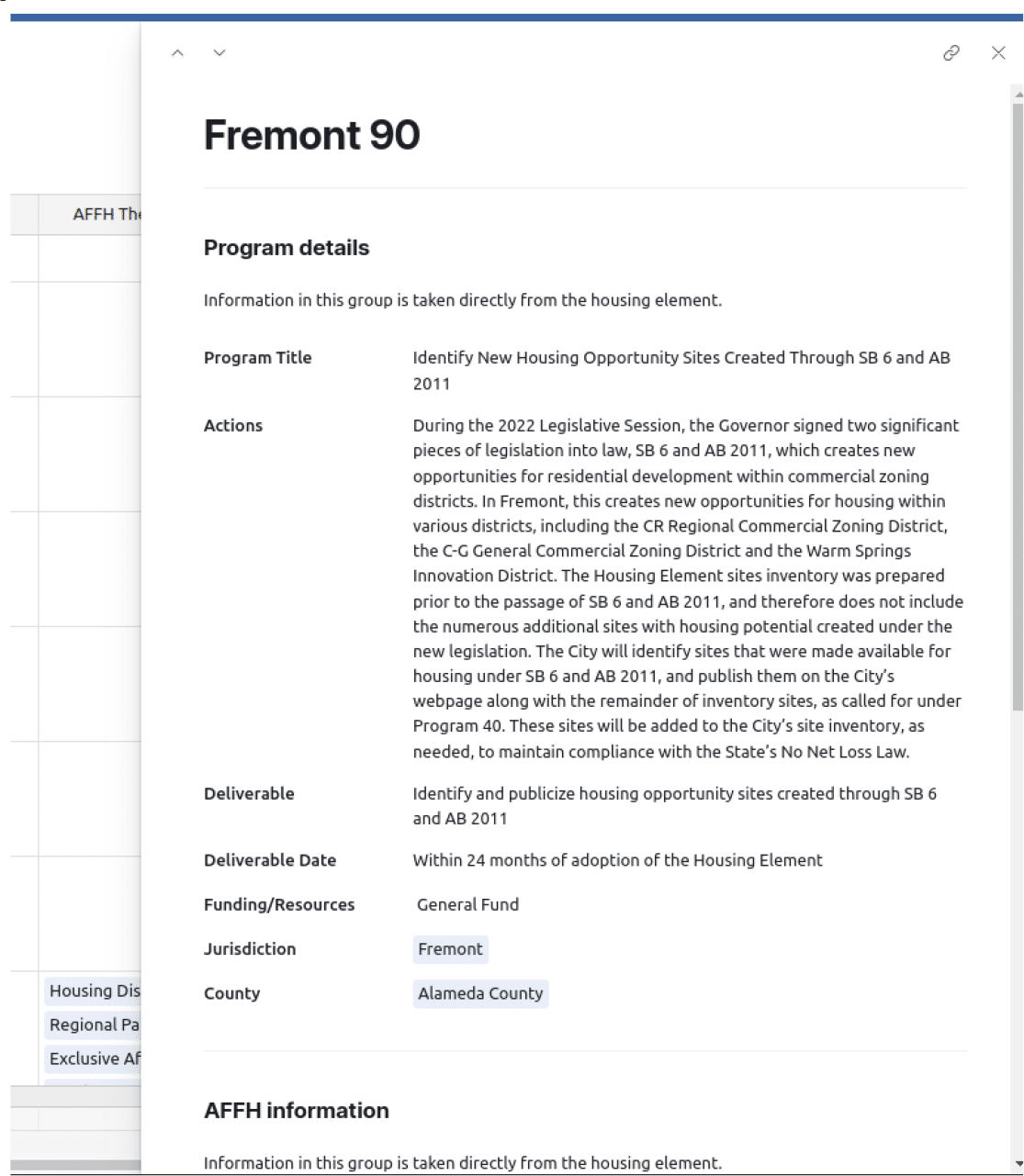
Users can click into any program to view all details and tags added by the Schafran Strategies Team.
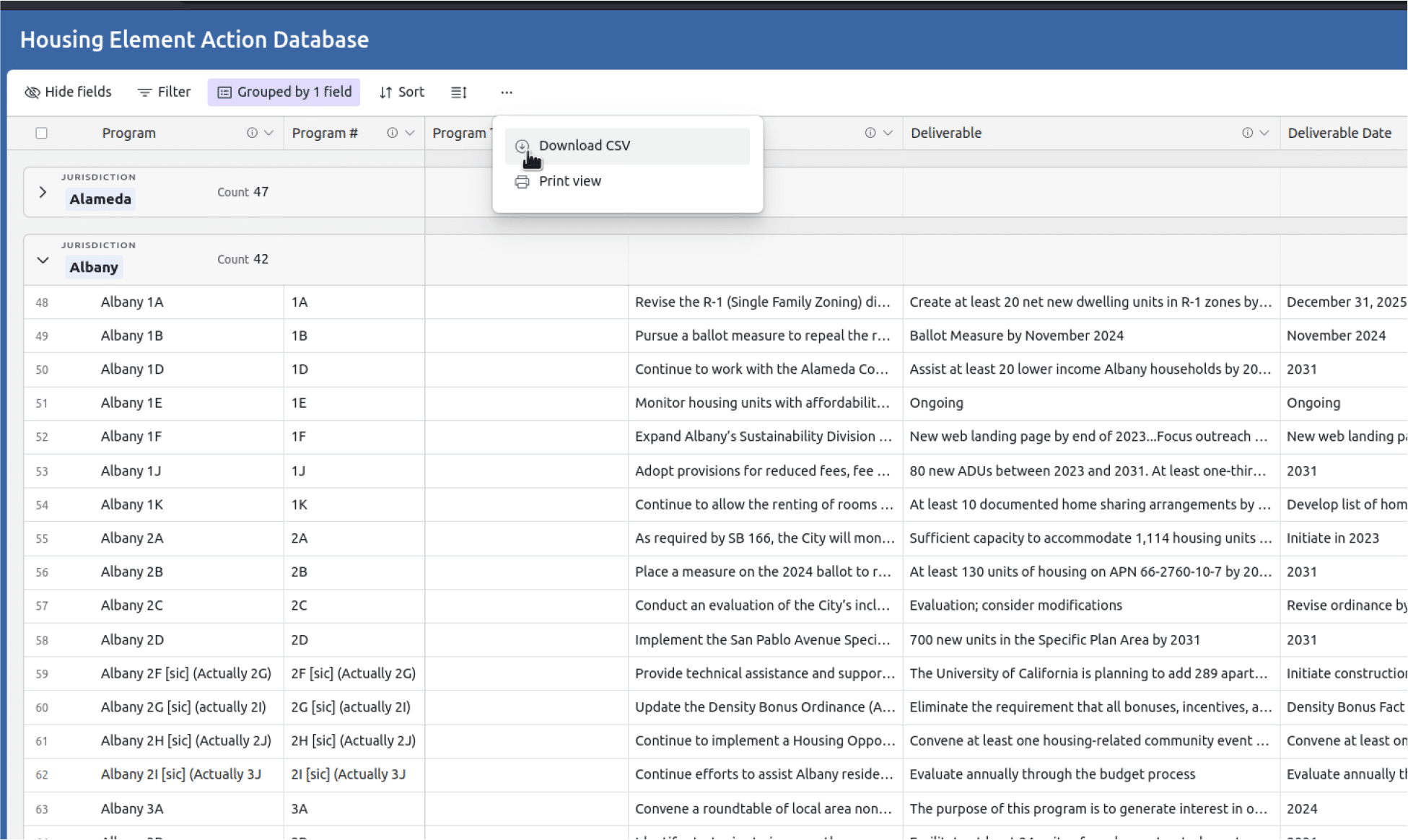
The “Advanced View” functions more like a traditional spreadsheet, and provides users with more robust filtering options and the option to export data as a CSV.
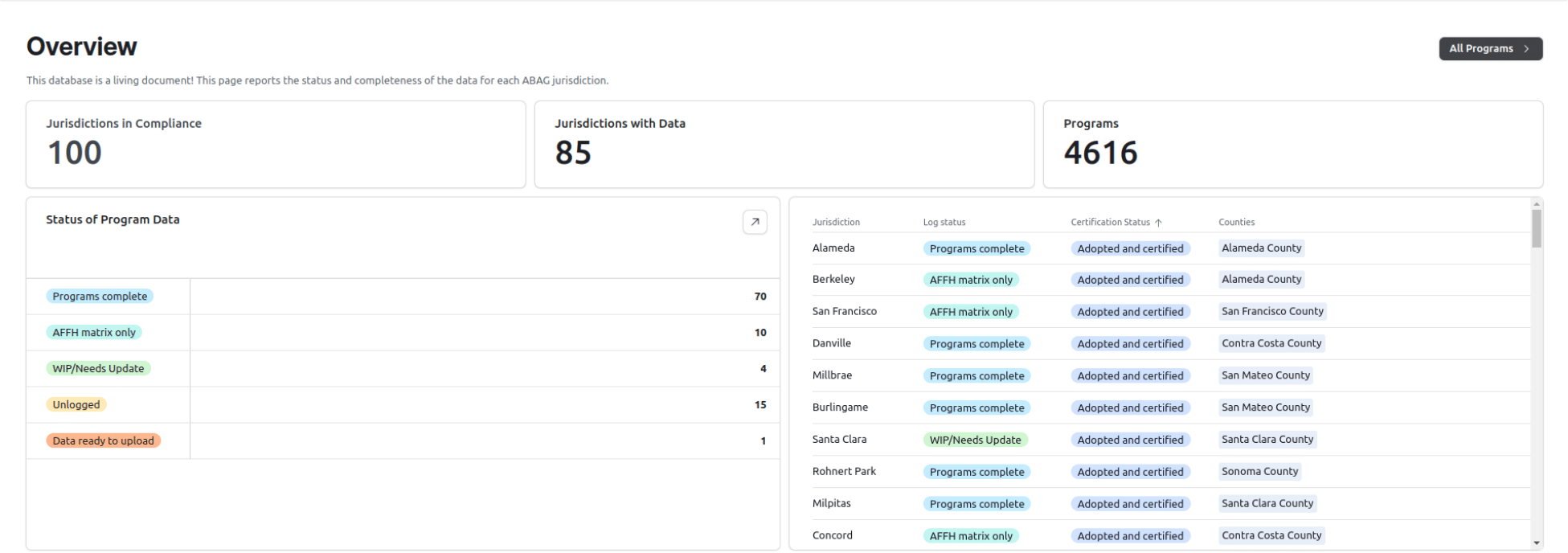
The overview page gives a broad look at the status and completeness of each jurisdictions’ data in the database. This page is a good way to track the progress of our coding team as we work to include all jurisdictions’ certified housing elements.
List of Jurisdictions included
- Alameda
- Antioch
- Benicia
- Brentwood
- Burlingame
- Colma
- Contra Costa County
- Cotati
- Danville
- Dixon
- East Palo Alto
- Fairfax
- Fairfield
- Foster City
- Fremont
- Gilroy
- Hayward
- Healdsburg
- Hillsborough
- Livermore
- Los Altos
- Los Altos Hills
- Marin County
- Menlo Park
- Mill Valley
- Millbrae
- Milpitas
- Moraga
- Morgan Hill
- Mountain View
- Napa
- Napa County
- Newark
- Novato
- Oakland
- Oakley
- Orinda
- Petaluma
- Piedmont
- Pinole
- Pleasant Hill
- Pleasanton
- Redwood City
- Richmond
- Rio Vista
- Rohnert Park
- Ross
- Saint Helena
- San Anselmo
- San Carlos
- San Jose
- San Leandro
- San Pablo
- San Rafael
- San Ramon
- Santa Rosa
- Saratoga
- Sausalito
- Sebastopol
- Solano County
- Sonoma
- Sonoma County
- South San Francisco
- Suisun City
- Sunnyvale
- Tiburon
- Union City
- Vacaville
- Walnut Creek
- Windsor
- Albany
- American Canyon
- Berkeley
- Brisbane
- Calistoga
- Cloverdale
- Concord
- Corte Madera
- El Cerrito
- San Francisco
- Campbell
- Dublin
- Emeryville
- Santa Clara